
Apple Index - "Black Limbertwig to Bushy Top"
Black Limbertwig

History: This apple was exhibited at the 1914 meeting of the Georgia Hort. Society. Prized for cider and apple butter.
Description: Fruit medium, roundish; skin mostly covered with bright red; dots scattered; stem short to medium in a wide, deep, russeted cavity; calyx closed; flesh yellowish, juicy, crisp, subacid, often described to have a spicy flavor. Ripe September/October. Genetically identical to Winesap but is probably a sport or mutation of it.
Black Sap

Fruit medium sized; skin greenish yellow completely covered with red stripes; dots large, numerous, raised; cavity shallow, acute, often russeted, stem short, moderately thick; basin shallow with mostly open calyx. Ripens September and stores well. Found by Tom Brown.
Blacktwig (Arkansas-Paragon, Mammoth Blacktwig, Arkansas, Big Blacktwig, Thorpe's Blacktwig, Pamplin's Eclipe, Big Winesap)

History: Starting in 1884, there was debate over Paragon versus Mammoth Blacktwig regarding the burning questions: Are these the same apple and, if not, which came first. People began looking back to find the origins of these two apples to see if those origins somehow converged into a single “mother tree,” a common progenitor of these two apples which were so remarkably alike. Sorting through the trees’ histories, there is no common origin for Paragon and Mammoth Blacktwig. They are both apparently seedlings of Winesap. The close resemblance of the fruit of Paragon and Mammoth Blacktwig fooled even the experts. It also resulted in nurseries so mixing up these two varieties that no one today can be absolutely sure which apple is which. This was Lee Calhoun's favorite apple, and is Jason Bowen's favorite as well.
Description: These descriptions are taken from old publications and are provided to let the reader compare Mammoth Blacktwig (Arkansas) and Paragon.
Mammoth Blacktwig (Arkansas): Fruit large, roundish oblate, conical; skin yellowish almost entirely covered with red; dots distinct, numerous, whitish. Flesh yellow with yellow veinings, firm, juicy, mild subacid. Ripe November-April.
Paragon: Fruit medium or above, roundish or sometimes somewhat oblate, slightly conical; sides often a little unequal; skin green or yellowish largely covered with dull, deep red with indistinct darker stripes; dots small, gray or white, sometimes rather conspicuous. Flesh pale yellow (Beach says greenish or tinged with yellow), firm, juicy, mild subacid. Ripe October-February.
Uses: Multipurpose, Stores well
Blairmont

Description: Fruit above medium, roundish, slightly oblique; skin covered with medium to dark red; dots tiny, whitish, scattered. Flesh pale greenish, fine grained, melting, juicy, subacid. Ripe August.
History: A modern apple, one of very few developed in the South in the past fifty years. It was bred at the USDA Experment Station in Byron, Georgia and released in 1982. It has not become popular, commercially or in the backyard, for several reasons. It tends to be a biennial bearer and ripens late July/August when it quickly becomes mealy. It is said to have good frost tolerance at blossom time.
Uses: Fresh Eating, Does not store well
Blue Ridge King

Genetically identical to Hoover
Boger

Description: Fruit medium size, usually oblate; skin rough, pale greenish, partly covered with dull red and often lightly to heavily overlaid with russet; dots rather large, scattered, whitish. Flesh pale yellow, moderately juicy, almost sweet. Ripe September/October.
History: This old apple, once used for drying and pies, was widely grown near Concord, North Carolina, where several trees still exist. Scions were provided by Jack Rankin of Concord. A Boger apple is grown around Columbia, Tennessee, but appears to be a different apple.
Uses: Drying, Cooking
Bower's Nonpareil (Big Green, Big Sweet)

Description: Fruit large, oblate, regular; skin pale yellow often shaded with red; dots numerous, russet and brown. Flesh white, rather fine-grained, tender, juicy, slightly aromatic, mild subacid or almost sweet. Ripe August.
History: Bower’s Nonpareil originated near Harrisonburg, Virginia. It was listed under the name Big Green and described as a new variety in the 1870 catalog of the Forest Nursery, Fairview, Kentucky. Downing (1900) says the tree bears annually but has larger crops on alternate years. Rediscovered by Elwood Fisher of Harrisonburg VA.
Bramley Seedling

An old English variety dating to the 1700’s from Southwell, Nottinghamshire. Today in Southwell there is a public house known as “The Bramley Apple.” Long considered by many apple enthusiasts as the “world’s best cooking apple”, Bramley’s Seedling quickly gained favor in this country for its tangy, sharp flavor and outstanding cider-making qualities. Fruit is very large and greenish-yellow in color with light red striping. Harvested from October through November and considered a fair keeper.
Uses: Cooking
Description courtesy of Big Horse Creek Farm at bighorsecreekfarm.com.
Branch (Pickett)

Description: Fruit medium size; skin greenish mottled with darker green and sometimes with a reddish blush on the sunny side. Nearly always a heavy bearer. Ripe Late July-August.
History: This is a local apple from Brunswick County, North Carolina, which lies on the coast near the South Carolina line. Branch is adapted to the warmer areas of the coastal pains. Doris Redwine of Ocean Isle Beach, North Carolina found this old variety which she enjoyed in her childhood.
Uses: Cooking
Brysons Seedling

Description: Large to very large; roundish to oblate; skin greenish yellow completely covered with stripes and splashes of red and dark red; cavity acute, medium, sometimes russeted with short to medium length stem; basin medium, somewhat shallow with open calyx. Ripe October.
History: From the 1904 catalog of the Maryland Nursery Company, Baltimore, Maryland: “Very fine, large, red, winter apple; one of the best growers and keepers, especially for the South. Originated in Jackson County, North Carolina. Samples of fruit received in February were sound and in fine condition.”
Uses: Fresh Eating, Cooking, Stores well
Buckeye Beauty

Description: Fruit medium size or above, roundish conical; skin bright yellow occasionally blushed with red. Flesh pale yellow, crisp, juicy, mild subacid. This apple has an excellent flavor that often tastes very similar to a pineapple. Very susceptible to fungal diseases. Ripe October and keeps well.
History: Listed but not described in the 1928 catalog of the Ideal Nursery and Orchard, Smithville, Tennessee. Listed as extinct in the first edition of Lee Calhoun’s book, but a single old tree has been found by Tom Brown at the home of Hershel Green in Watauga County, North Carolina.
Uses: Fresh Eating, Stores well
Buckingham (Queen, Fall Queen, Winter Queen, Kentucky Queen, Equinetelee, Byers, Merit, Ne Plus Ultra, Bachelor, Fall Cheese, Large Summer Pearmain)
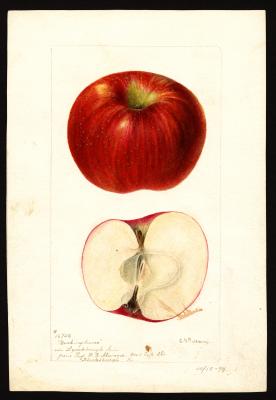
Description: Fruit usually large but varies in size even on the same tree, roundish, but often somewhat oblate, slightly conical, often oblique; skin smooth, thick, greenish yellow or yellow mostly covered with dull red stripes and marbling, darker red on the sunny side; dots numerous, small, light brown or white. Flesh yellowish, tender, juicy, sprightly subacid. Ripe early fall in the mountains, late summer in warmer areas.
History: Buckingham is the quintessential southern apple. It was grown for two hundred years all over the South where it was valued for the large size and high flavor of the fruit and the vigorous productiveness of the tree. In 1777, Colonel John Byers was growing an apple he called Queen in his garden in Louisa County, Virginia. It was locally called Byer’s Apple or Byer’s Red. There is good reason to believe this apple was the Buckingham. Probably this apple made its way south into Surry County, North Carolina, carried by settlers who called in Buckingham because they had acquired it in Buckingham County, Virginia. About 1795, a settler named Edward Dornaby moved from Virginia to Mercer County, Kentucky, and started a nursery there. He is believed to have introduced Buckingham west of the Appalachians under the name Queen. It spread from Kentucky into Missouri and Indiana as Queen or Kentucky Queen, while simultaneously it spread from North Carolina into Tennessee and thence into Illinois under the name Buckingham.
Uses: Multipurpose, Stores well
Bud Wolf

Description: Fruit large, roundish, irregular; skin pale yellow, washed and striped on the sunny side with red. Flesh moderately crisp and juicy, pale yellow, fine-grained, mild subacid to almost sweet. Ripens September.
History: Daniel Dixon, Jr. of Lowgap, North Carolina had the only known tree of this variety. He said it originated long ago as a seedling in Harford County, Maryland. Dr. Dixon described the fruit as “a real good cooking apple and also good to eat raw.”
Uses: Fresh Eating, Cooking
Buff (Granny Buff, Pound, Mountain Sprout, Big Buff)

Description: Fruit of the largest size, irregular, roundish, oblate, somewhat ribbed, sides unequal; skin thick, whitish yellow overspread with broad, broken splashes and stripes of dark crimson or dull red, very dark on the sunny side; dots few, greenish russet. Flesh yellowish or greenish white, tender, somewhat coarse, moderately juicy, subacid, mealy when fully ripe. Ripens Late September.
History: In the May 1853 Western Horticultural Review magazine, the following history of Buff is given: “A well known apple which originated in Haywood County, North Carolina. The original tree was found growing on the farm of a German man by the name of Buff. It was a seedling tree raised by the Cherokee Indians. Many fine varieties have been grown by them as they know of no other way of propagating fruit than from the seeds.”
Buff has long been esteemed in western North Carolina for cooking, drying, and making apple butter. The quality of Buff has been described as very good under favorable conditions and when well ripened but otherwise “indifferent.”
Uses: Fresh Eating, Cooking, Drying, Apple Butter
Buncombe (Red Winter Pearmain, Batchelor, Bunkum, Buncombe Pippin, Red Fall Pippin, Meigs, Powers, Tinson's Red, Southern Fall Pippin, Red Vandevere, Jackson's Red, Robertson's Pearmain, Red Lady Finger, Red Gilliflower, Kirby's Red, Lady Finger Pippin)

Description: Fruit large, somewhat segmented, roundish to slightly oblate, conical; skin nearly covered in pale red with numerous darker red, broken stripes; dots small and large, tan or russet. Flesh whitish, juicy, moderately crisp, fine-grained, subacid. Ripe July/August.
History: When an apple has as many synonyms as Buncombe, you can be sure it is an old variety once grown over a wide area. In 1867 Warder called it “a favorite southern apple, widely diffused through the South…” Lee Calhoun grafted Buncombe scions from two different sources in Tennessee that produced identical fruit. The fruit does not in any way resemble the descriptions in old apple references. The description above is for the fruit as currently being grown.
Uses: Cooking
Burl (Cager)

Description: Medium sized apple; skin yellow with numerous light brown dots; calyx open. Ripe July-August.
History: Burl is a local apple still grown by Herbert Childress in his extensive preservation orchard in Dunnville, Kentucky. He describes it as follows: “A late summer yellow apple, tart, spicy flavored, aromatic. A good all around apple.”
Uses: Fresh Eating, Cooking
Bushy Top

Description: Medium sized, roundish to roundish conical; skin yellowish with stripes of red and darker red starting at cavity and completely covering sunny side; dots white, raised, dotted sparsely over apple; cavity acute, medium with medium length stem; basin shallow, somewhat narrow with mostly open calyx. Ripe September.
History: Origin unknown, found by Tom Brown of Clemmons, NC.