
Apple Index - "D"
Dan McDaniel

Description: Fruit above medium with roundish conical shape; dots raised, whitish; skin yellow with stripes of varying shades of red throughout sunny side. cavity medium, acute with moderately long stem, sometimes faintly russeted; basin shallow, medium, with mostly open calyx. Very attractive apple. Ripe September.
Deacon Jones
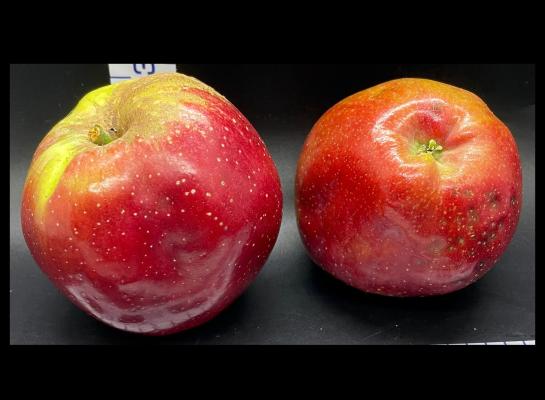
Description: Large to very large, roundish conic to oblong conic, ribbed, skin thick, tough, smooth or slightly rough, waxen yellow mottled and washed with red, irregular splashes of carmine, sometimes completely covered with attractive deep red; dots conspicuous, whitish. Stem short. Cavity obtuse to acute, shallow to mod. deep, narrow. Basin shallow to mod. deep. Calyx small to above medium, closed or partly open. Flesh whitish, sometimes tinged with yellow, firm, coarse, somewhat crisp, tender, moderately juicy, mild subacid, slightly aromatic, fair to good quality. Ripe in NC in Sept.
History: Chance seedling found on the farm of a man named Deacon Jones from PN around 1890. He sent scions to a man named Mr. Freeman from Rochester NY.
Resources: Beach/1905, Bussey/2016
Deaderick (Ben Ford, Ozark Pippin)

Description: Fruit large, roundish conical, sides sometimes unequal; skin tough, smooth, lemon yellow, often with a pinkish blush and having a few large, reddish, areolar spots; dots black and brown, many with pink or green bases. Flesh yellowish, fine-grained, breaking, juicy, mild subacid. Ripe late September/October.
History: Originated about 1850 with Benjamin Ford of Washington County, Tennessee, where it was called Ozark Pippin. An 1896 Tennessee agricultural experiment station bulletin describes it under the name Deaderick, a name change probably necessary because another apple was named Ozark. In 1992 Richard Moyer found apple trees being grown in Tennessee called Ozark Pippin, and examination of the fruit proves that this apple is Deaderick.
Uses: Fresh Eating
Dee Moore Late Strawberry

History: This apple was donated to the Southern Heritage Apple Orchard by Doug Hundley in Avery County from a 100+ year old orchard. Jason Bowen, Southern Heritage Apple Orchard's Horticulturalist, visited the orchard and tried the apple before grafting. Has a slight strawberry flavor.
Description: Fruit small, roundish, skin greenish yellow striped with red, dots brownish; cavity somewhat shallow, acute with russet spilling over the top, stem long, slender; basin shallow, narrow. Ripe October
Democrat

Description: Small to medium sized apple, oblate; skin green, mostly covered in stripes of pinkish red and darker red; dots white, somewhat numerous; cavity shallow, acuminate with moderately thick, short stem; basin shallow, medium with open calyx. Ripens October.
Uses: Fresh Eating
Devine

Description: Fruit medium to almost large, roundish conical; skin mostly covered with bright red with faint red stripes more obvious at the basin end; dots scattered, tannish, rather large but smaller near the basin. Flesh greenish, fine-grained, subacid. Ripe July/August.
History: Joyce Neighbors, a nurserywoman in Gadsden, Alabama, found this apple being grown by Mrs. J. B. Devine. Family lore is that a “sprout” of the apple was carried from South Carolina to Alabama in 1895.
Uses: Cooking
Dickenson

Description: Medium to large in size, roundish oblong conic, sometimes compressed or broadly angular, sides sometimes unequal. Skin smooth, light yellow or green, blushed and mottled with bright red, striped with darker red. Flesh yellowish, juicy to very juicy. Moderately fine textured, slightly aromatic, subacid, moderately firm, tender. Ripe late.
History: This is a seedling of Bellflower planted by Sarah H. Dickenson of Westchester, Pennsylvania, first recorded in 1878.
Uses: Fresh Eating
Disharoon
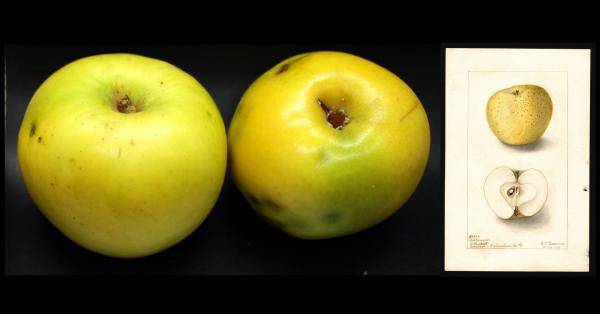
Description: Fruit medium, roundish, flattened on the ends; skin green with a yellowish or golden hue on the sunny side; dots numerous, obscure, greenish with russet centers, submerged. Flesh pale yellow, moderately juicy and crisp, sweet. Ripe September/October.
History: An old Georgia apple, thought to be an Indian seedling, found in Habersham County, Georgia, “by a man named Disharoon.” Jim Lawson of Lawson’s Nursery grafted several Disharoon trees in the 1970s for nearby family members of that name. Lee Calhoun found Disharoon apple trees in north Georgia on an old family farm owned by Juanita Davis in 1998.
Uses: Fresh Eating
Domine (Dominie, American Nonpareil, English Rambo, English Red Streak, English Beauty, Wells, Cheat, Cling Tight, Striped Rhode Island Greening, Hogan, Williamson, Winter Rambo, Red Streak)

Description: Fruit medium, oblate, sometimes oblique; skin thick, smooth, striped and splashed with red and russet streaks in the sun, some bloom; dots rather large, scattered, irregular, yellowish gray with russet centers. Flesh white or tinged yellow, very firm, breaking, almost coarse, juicy, mild subacid, somewhat aromatic. Ripe October.
History: Domine, widely grown in the South before 1900, is listed most often in old southern nursery catalogs under the name Dominie. In spite of such synonyms as English Beauty and English Red Streak, Domine is probably of American origin before 1800. Elliot (1858) says it may have originated in Maryland, but Domine was first mentioned by name in an 1805 Virginia nursery catalog.
Donce

Bobby Johnson of Traphill, North Carolina, has the only known tree. He told Tom Brown that the apple originated with Donce Johnson, one of the earliest settlers in Wilkes County. Described as large, roundish conical; skin light green splashed and striped with red; flesh firm, crisp, juicy, subacid. Ripe August.
Uses: Cooking
Doctor Matthews
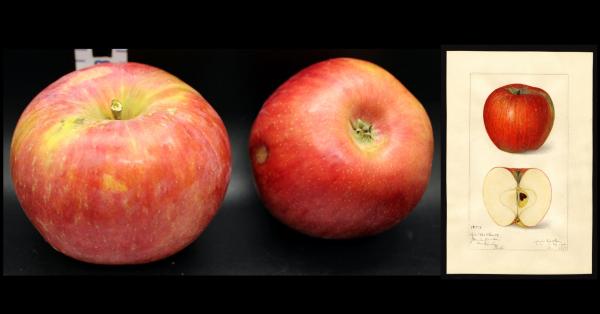
Description: Fruit above medium, roundish conical, flattened on the ends, often oblique; skin tough, yellow with pale red and some stripes on the sunny side, mostly red in the sun; dots numerous, light colored, many with russet centers. Flesh cream-colored, fine grained, crisp, juicy, aromatic, almost sweet. Ripe September.
History: First grown by Dr. W. F. Matthews of Brazil, Tennessee, and listed in 1895 by Planters Nurseries of Humboldt, Tennessee.
Uses: Fresh Eating
Dula's Beauty (Dula)

Description: Fruit large, or very large, roundish or slightly oblate, conical, irregular, and often oblique; skin rough, almost entirely covered with dark red with obscure darker stripes; dots medium size, scattered, grayish. Flesh yellowish white, tender, crisp, juicy, mild subacid. Ripe September/October.
History: Originated in the late 1800s in Lenoir, Caldwell County, North Carolina, from Limbertwig seeds that Mr. J. A. Dula planted to grow rootstocks for grafting. Dula’s Beauty was recommended in 1908 by the North Carolina Department of Agriculture for growing in the Piedmont. One very old tree was found in 1990 in an old orchard in Watauga County, North Carolina belonging to Inadene Hampton and her two sisters, all octogenarians.
Uses: Fresh Eating, Cooking, Stores well
Duncan

Description: Fruit medium to large, round; skin red-striped. Ripe winter. This apple is different from the Duncan described by Downing (1878)
History: From an 1895 letter to the USDA from W. M. Samuels, Clinton, Hickman County, Kentucky: “I found a single tree of this apple at George Pucket's, 10 miles south of Hickman, with a fine crop of firm, good fruit. He called it Duncan. Mr. Pucket, now dead, was a large fruit grower in that section. The tree bears every other year and originated about 1872.” Tree found by Tom Brown.
Uses: Fresh Eating, Stores well
Durham

Velma Johnson of Traphill, North Carolina, owned the sole surviving tree. Tom Brown says there were many trees of the Durham apple around that area thirty years ago. Described as small, oblate, slightly conical; skin covered with a brownish yellow rough russet; flesh firm, crisp, acid. Ripe August/September.
Uses: Fresh Eating, Cooking